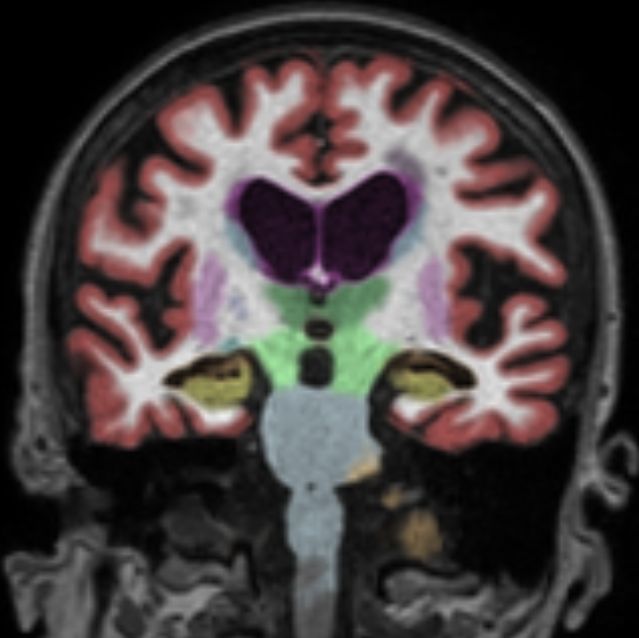
A biomarker is a measurable sign in the body that can point to a disease or to a change in health. In dementia and related brain diseases, certain parts of the brain gradually shrink, and these changes can begin years before memory problems become obvious. These changes in the brain are called biomarkers, and they can be detected with MRI, using a technique called brain volumetry.
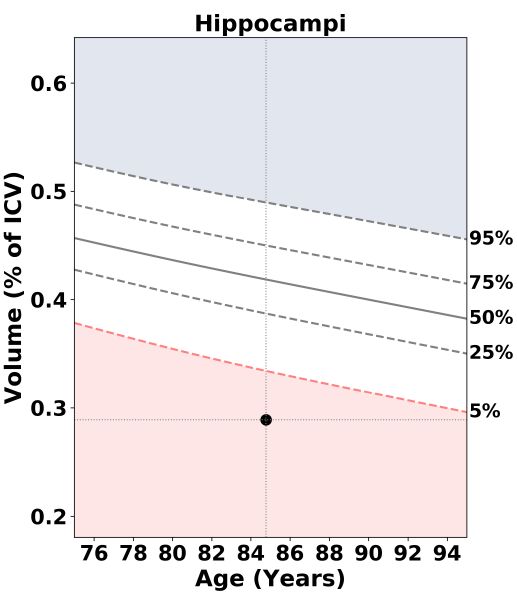
Hippocampus volume (biomarker) compared on a percentile chart.
Brain volumetry measures the volume of specific brain structures, such as the hippocampus, an area deep in the brain that plays a central role in forming new memories. The scan can compare your measurements with those of other people of your age, using a percentile chart, and show whether any part of your brain is smaller than expected. AI software is used to map the different structures of the brain, which are shown on the report in a colour-coded brain map.
What Is the Role of MRI in Dementia?
An MRI scan is a painless and non-invasive imaging procedure that uses magnetic energy to image the brain. There is no radiation, and no contrast dye injection is involved.
It is the most comprehensive imaging tool in the primary evaluation of a person demonstrating symptoms suspected of dementia, memory loss and related brain diseases. It also helps to exclude underlying treatable causes of memory problems, such as tumours, strokes and abnormal blood vessels in the brain.
How Does It Differ From a Routine MRI Scan?
- A routine MRI scan of the brain takes pictures of the brain and shows its structure. It is good for finding tumours, strokes and bleeding.
- An MRI brain volumetry scan is an enhanced imaging test that takes pictures and also volume measurements of the brain. It gives a better view of brain shrinkage that may not be obvious on a routine MRI.
- The imaging experience is the same. The difference is that the report gives you additional information about disease biomarkers.
- The scan can also give detailed information on damage to the blood vessels in the brain, which is useful in the assessment of vascular dementia, a type of dementia caused by reduced blood flow to the brain. This is covered by the MRI Dementia Screen Plus.
Which Scan Is Right for You?
There are three types of dementia biomarker screen MRI scans available at Farrer Park Hospital:
- MRI Dementia Screen: includes an MRI of the brain and MRI volumetry
- MRI Dementia Screen Plus: includes an MRI of the brain, an MRA (magnetic resonance angiography, a scan of the blood vessels) of the brain, an MRA of the carotid arteries in the neck, and MRI volumetry
- MRI Volumetry Only: for patients who have had a recent MRI of the brain, or for follow-up volumetry
Who May Benefit From This Scan?
- People who are noticing memory loss, or changes in thinking, language, judgement or behaviour, that are more than the usual forgetfulness of ageing
- People whose family members or friends have noticed such changes
- People with mild cognitive impairment, who need to be monitored over time
- People who have been diagnosed with dementia, and need follow-up volumetry to track changes
- People with risk factors for dementia, such as a strong family history, high blood pressure, diabetes or a past stroke, who are worried about their memory
Why This Matters in Singapore
Singapore’s population is ageing rapidly, and dementia is becoming more common. The Well-being of the Singapore Elderly (WiSE) study, led by the Institute of Mental Health, found that about 1 in 11 Singapore residents aged 60 and above (8.8%) had dementia in 2023. The risk increases sharply with age, affecting nearly half of those aged 85 and above.
The study also found that around half of those with dementia had not yet been diagnosed. Many families put memory changes down to “just getting old”, and delay seeing a doctor. An early diagnosis allows you and your family to start treatment where appropriate, find and treat any reversible causes, and to plan ahead while the person can still take part in decisions.
In Singapore, this includes legal and care planning, such as making a Lasting Power of Attorney (LPA), which allows you to appoint someone you trust to make decisions on your behalf if you lose the mental capacity to do so later. An LPA can only be made while you still have mental capacity, which is one reason why early diagnosis matters. It is also a good time to talk about your wishes for future care with your family, and to find out about support services.
Possible Warning Signs of Dementia
- Forgetting recent conversations or events, and asking the same questions repeatedly
- Misplacing things in unusual places, or getting lost in familiar places
- Difficulty planning, handling money or following familiar recipes or tasks
- Trouble finding the right words, or following conversations
- Confusion about time, place or people
- Changes in mood, personality or behaviour, such as becoming unusually withdrawn, suspicious or irritable
Preparing for Your MRI Scan
- Eating, drinking and medication: You may eat, drink or take any medication as usual on the day of the scan, unless you are otherwise advised.
- Safety screening: Our staff at the imaging department will ask you questions about your health and medical history to ensure that you have a safe and comfortable imaging experience. Please tell us if you have a pacemaker, defibrillator, brain aneurysm clips, cochlear implants, metal implants or fragments, or have had recent surgery. Some devices are safe for MRI, but we need to check first.
- Remove all metal objects: The MRI scanner produces strong magnetic fields that can damage the items or cause injury to yourself or the staff. Examples of these items include piercings such as ear, nipple and nose rings, jewellery such as earrings and necklaces, dentures (false teeth), watches, and wigs (some wigs contain traces of metal). Hearing aids, hairpins and clothing with metal parts must also be removed.
- Hospital gown: You will be required to change into a hospital gown before the procedure. A locker will be provided for you to store your valuable items.
- Claustrophobia and anxiety: If you are uncomfortable in enclosed spaces, tell us beforehand. You may be advised to undergo the procedure with sedation.
- Pregnancy: Tell us if you are pregnant or think you may be pregnant.
- Bring a companion: If you or your family member has memory problems, it helps to have a family member or caregiver with you, to give the medical history and to support the person through the visit.
- What to bring: Your doctor’s referral letter, your NRIC (or passport if you are an international patient), previous brain scan reports or images, and a list of your medications.
What to Expect During the Scan
- You will lie flat on a motorised bed, which will move you into the scanner head first. A frame will be placed over your head during the scan.
- A radiographer trained in carrying out the procedure will operate the MRI scanner, and can see and speak to you throughout.
- The scan is a painless procedure that will take 8, 15 or 30 minutes depending on the specific type of scan.
- It is essential to keep as still as possible during the scan, to obtain clear images. Movement can blur the results, especially for volume measurements.
- You will be given earplugs to protect your ears, as there will be loud, repetitive noises during the procedure.
- If you experience claustrophobia, you may be advised to undergo the procedure with sedation.
After the Scan
- You will be able to leave the hospital immediately after the procedure and resume your normal activities.
- If you were sedated for the procedure, you will rest in a recovery room until you are awake and feel well enough to leave. You should have someone accompany you home, and should not drive for the rest of the day.
- A specialist doctor will review your images and prepare a report, which will be sent to your doctor.
- Your doctor will go through the results with you, and explain what they mean.
Understanding Your Results
The report will describe your brain structures, and show your volume measurements compared with others of your age, often on a percentile chart.
- Smaller than expected volumes in certain areas, such as the hippocampus, can be consistent with Alzheimer’s disease or other conditions that affect memory. The pattern of shrinkage can help doctors tell the different types of dementia apart.
- Volumes within the expected range are reassuring, but they do not completely rule out early dementia or other causes of memory problems.
- Some shrinkage happens normally with age, and brain size varies between individuals. A scan finding alone cannot diagnose dementia.
- Other findings, such as tumours, strokes or fluid build-up, may point to treatable causes of memory problems.
Dementia is diagnosed by a doctor, based on a full assessment, which includes your history, a physical examination, memory and thinking tests, blood tests and brain imaging. Your doctor will consider the scan together with all of this information. Other tests, such as an amyloid PET brain scan, may sometimes be suggested to give further information. Your doctor may also repeat the volumetry scan after a period of time to see how your brain is changing.
What Happens Next?
- If the cause of your memory problems is treatable, your doctor will start treatment and review you to see if you improve.
- If dementia is diagnosed, your doctor will discuss treatment options, which can help to manage symptoms and, in some cases, slow their progress, and will advise you on care and support. Your doctor may refer you to a specialist such as a neurologist, geriatrician or psychiatrist.
- Support is available in Singapore through organisations such as Dementia Singapore and the Agency for Integrated Care (AIC), which offer information, caregiver support, day care and referrals to community services.
- Caregivers also need support. Please look after your own health, and ask for help early.
Looking After Your Brain Health
- Keep your blood pressure, blood sugar and cholesterol under control, with regular check-ups
- Be physically active: aim for at least 150 minutes of moderate physical activity every week, as advised by your doctor
- Keep your mind active, with reading, learning, hobbies and puzzles
- Stay socially connected with family, friends and community activities
- Do not smoke, limit alcohol and eat a balanced diet
- Have your hearing and eyesight checked, and use hearing aids or glasses if needed
- Get enough sleep, and seek help for low mood
- Protect your head from injury, for example by using a helmet when cycling and by preventing falls at home
You may check with your doctor or reach out to us at
+65 6363 1818 to find out more. You may also send an enquiry
here.