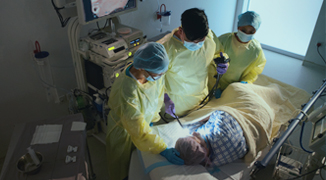
An endoscopy gives a specialist a direct view inside the body — through the digestive tract, into the airways and lungs, or down to the biliary system — without open surgery. It is one of the most important diagnostic and therapeutic tools in modern medicine: the procedure that finds a colorectal polyp before it becomes cancer, confirms a diagnosis without a single external incision, removes a lodged object from a child's airway, or treats a bleeding vessel in the stomach.
Farrer Park Hospital's Endoscopy Suite on Level 5 is a dedicated facility for both diagnostic and therapeutic endoscopic procedures, serving patients across general surgery, gastroenterology, respiratory medicine, and upper gastrointestinal surgery. The suite performs the full range of gastrointestinal endoscopy, respiratory endoscopy including bronchoscopy, and emergency procedures such as foreign body removal from the trachea.
Endoscopy is a minimally invasive medical procedure in which a thin, flexible tube fitted with a light source and a high-definition camera — called an endoscope — is passed into the body through a natural opening or a small incision. The camera transmits real-time images to a monitor, giving the specialist a direct visual inspection of the internal structures being examined.
Modern endoscopes carry more than a camera. Through their working channel, specialists can pass instruments for biopsy, inject medications, apply heat or electrical current to stop bleeding, place stents, or remove tissue — all without a single surgical incision. This makes endoscopy both a powerful diagnostic tool and, increasingly, a treatment modality in its own right.
Endoscopic procedures at Farrer Park Hospital span three organ systems. Gastrointestinal endoscopy examines and treats the oesophagus, stomach, small intestine, large intestine, rectum, gallbladder, bile ducts, and pancreatic ducts. Respiratory endoscopy (bronchoscopy) examines and treats the airways and lungs. Emergency endoscopy manages conditions such as foreign body obstruction of the trachea, which requires immediate intervention.
Endoscopy sees what no scan can show with the same certainty: the lining of the organ itself, in real time, with the ability to act immediately on what is found.
This procedure examines the upper digestive tract, including the esophagus, stomach, and the first part of the small intestine (duodenum). It’s commonly used to diagnose causes of symptoms like abdominal pain, nausea, vomiting, swallowing difficulties, or bleeding. It can also detect ulcers, inflammation, tumors, and allow for biopsies or treatment such as removing polyps.
This examines the entire large intestine (colon) and rectum using a longer endoscope inserted through the anus. It’s primarily used to screen for colorectal cancer, investigate causes of chronic diarrhea, bleeding, or abdominal pain, and remove abnormal growths such as polyps.
Polypectomy
A polypectomy is a medical procedure used to remove polyps—abnormal growths of tissue that can develop on the lining of organs such as the colon, stomach, or nasal passages. Removing polyps is important because some can potentially develop into cancer over time. Often performed during an endoscopy or colonoscopy, a polypectomy involves using specialized tools passed through the endoscope to safely excise the polyp.
A diagnostic endoscopy is performed to look and assess: to examine a lining, take a biopsy, or identify a lesion. A therapeutic endoscopy does something in addition to looking — it treats. The two are not always separable.
A colonoscopy scheduled as a routine cancer screening procedure may become therapeutic the moment a polyp is found and removed. An ERCP performed to investigate obstructive jaundice treats the cause if a gallstone is found blocking the bile duct. Endoscopy's power lies precisely in this flexibility: the transition from diagnosis to treatment can happen in a single procedure, in the same room, without the patient needing to be scheduled for a separate operation.
At Farrer Park Hospital, both diagnostic and therapeutic endoscopy are performed in the same suite. The facility is equipped with the instruments needed for the full range of therapeutic interventions — including polypectomy snares, haemostatic clips, injection needles, argon plasma coagulators, and ERCP accessories — so that the specialist can respond to intraoperative findings immediately, without deferral.
The same procedure that screens can also treat. That is what makes endoscopy one of the most clinically efficient tools in a specialist's hands.
At Farrer Park Hospital, the Endoscopy Suite is designed to be a private, calm environment — not a high-throughput procedure room. Each patient has their own space, their own bathroom, and a team that is focused on them rather than the next person in the queue.
Recovery rooms are equipped for patient comfort and family communication, with nursing staff available throughout the observation period.
All procedure conversations, consent discussions, and post-procedure findings are conducted privately, not in shared spaces.
Most procedures are performed under conscious sedation or monitored anaesthetic care. Your specialist will explain the sedation approach specific to your procedure.
Each procedure is led by the specialist who referred or was chosen by you — not a trainee or deputy. Nursing and endoscopy technician support is procedure-specific and experienced.
Preliminary findings are discussed with you before discharge. Biopsy results and formal reports are communicated by your specialist at follow-up.
Preliminary findings are discussed with you before or at discharge. Biopsy results typically return within five to seven working days. Your specialist will contact you or schedule a follow-up appointment to discuss results and determine next steps in management.
| Before You Arrive | Your specialist will provide preparation instructions specific to your procedure. For colonoscopy, this includes a bowel preparation regimen starting the day before. For gastroscopy and bronchoscopy, fasting for several hours is required. Medication instructions — particularly for blood thinners and diabetic medications — will be given in writing at the pre-procedure consultation. |
| Arrival & Registration | Arrive at Level 5 as directed. The nursing team will confirm your identity, review your consent form, check vital signs, and establish intravenous access if sedation is planned. You will change into a procedure gown and be settled in your private room before the procedure begins. |
| The Procedure | Depending on the procedure, you will be positioned on the procedure bed — on your left side for most GI endoscopies, seated or supine for bronchoscopy. Sedation is administered if required. The procedure typically takes 15 to 45 minutes for standard diagnostic endoscopy, and longer for therapeutic procedures such as ERCP or ESD. You will be monitored continuously throughout. |
| Recovery | After the procedure, you are transferred to your private recovery room. Nursing staff monitor your vital signs, sedation recovery, and comfort. Bloating or mild discomfort is common after GI endoscopy and typically resolves within an hour. Sore throat after gastroscopy or bronchoscopy is expected and transient. Recovery duration is typically one to two hours for standard procedures. |
| Discharge | You will be assessed for discharge readiness by the nursing team and cleared by the specialist. For procedures involving sedation, you will need a responsible adult to accompany you home — you should not drive. Written discharge instructions and dietary guidance are provided. For international patients, post-procedure advice includes guidance on travel readiness. |
| Follow-up | Preliminary findings are discussed with you before or at discharge. Biopsy results typically return within five to seven working days. Your specialist will contact you or schedule a follow-up appointment to discuss results and determine next steps in management. |
Contact: (65) 6705 2980
Location: Level 5
Operating Hours:
Mon - Fri: 8 a.m. – 5 p.m.
Sat: 8 a.m. – 1 p.m.
Sun & PH: Closed